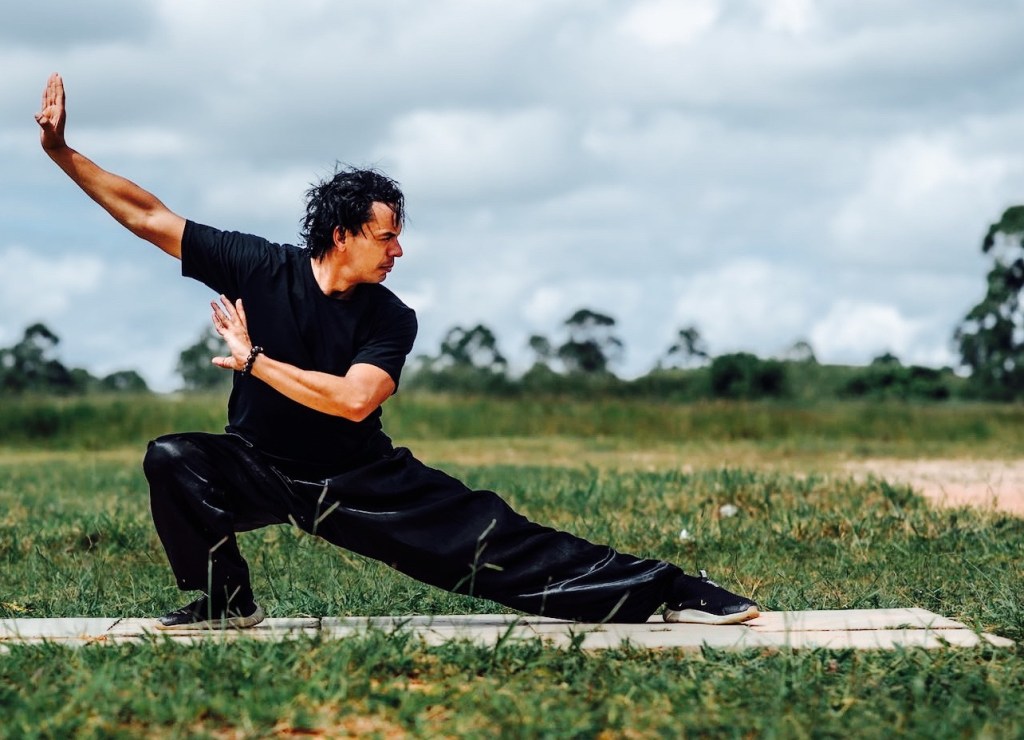
I recently took my first Tai chi class after reading about its many benefits. I was looking for improved balance but learned much more.
Read about other exercises to improve your balance here: https://lindawbrowning.com/2023/02/10/exercise-keeping-balanced/
Tai chi is a traditional Chinese exercise based on the martial arts (1). Its slow breathing and pacing are reminiscent of yoga. In my area, Tai chi is frequently taught at martial arts and yoga studios. Either can be a good choice, depending upon the direction you’d like to take your Tai chi practice. Watching videos is also a great option that will save you money, but it can’t give you individualized corrections on form.
There are many benefits to adding Tai chi to your exercise or self care routines. I’ve created the partial list below, but you may be aware of more.
Tai chi:
- Has been found to be even more effective in reducing abdominal fat than a combination of weight training and aerobics in a nine month study. Participants’ waist measurements were compared to a control group and it was found that theirs were reduced “by 0.7 inches more with tai chi, and 0.5 inches more with brisk walking and strength training” (2). It’s important to note that the study subjects were over age 50.
- May help with mood, anxiety, and depression, though further study is needed to confirm this (4).
- Is an excellent workout, strengthening “both the lower and upper extremities and also the core muscles of the back and abdomen” (3). It also improves flexibility and balance. “Proprioception — the ability to sense the position of one’s body in space — declines with age. Tai chi helps train this sense, which is a function of sensory neurons in the inner ear and stretch receptors in the muscles and ligaments” (3).
- Has been shown to improve sleep quality and anxiety in younger (18-40) adults (5).
- May improve cognition for those with minor dementia. Tai chi “training significantly improved memory and the mental switching component of executive function in older adults with a-MCI [amnesiac mild cognitive impairment]” (6).
- Could reduce the fear of and risk of falling in older adults if it is practiced for four and eight weeks, respectively (7).
- Improves symptoms or helps in coping with several diseases, including fibromyalgia, chronic obstructive pulmonary disease (COPD), Parkinson’s, and arthritis (8).
- Aids in the recovery of breast cancer (9). I personally don’t think it’s a stretch that it could be helpful for all cancer survivors and thrivers.
Might you consider adding Tai chi to either your exercise of self-care routines? There are many videos to try if classes don’t work out for you. Why not try to see if it can help us maintain our healthy weight?
(1). https://www.nccih.nih.gov/health/tai-chi-what-you-need-to-know
(3). https://www.health.harvard.edu/staying-healthy/the-health-benefits-of-tai-chi
(4). https://www.researchgate.net/publication/321299648_Qigong_and_Tai-Chi_for_Mood_Regulation
(5). https://www.ncbi.nlm.nih.gov/pmc/articles/PMC5118018/
(6). https://journals.sagepub.com/doi/10.1177/1545968317753682
(7). https://www.ncbi.nlm.nih.gov/pmc/articles/PMC5857038/
(8). https://www.healthline.com/health/tai-chi-benefits#improves-cognition
 Maintain Weight Loss
I’m really enjoying your posts Linda. I’ve been interested in trying tai chi for years. Maybe now is the time
LikeLiked by 1 person
Thanks, Peggy! Let me know if you enjoy it.
LikeLike