
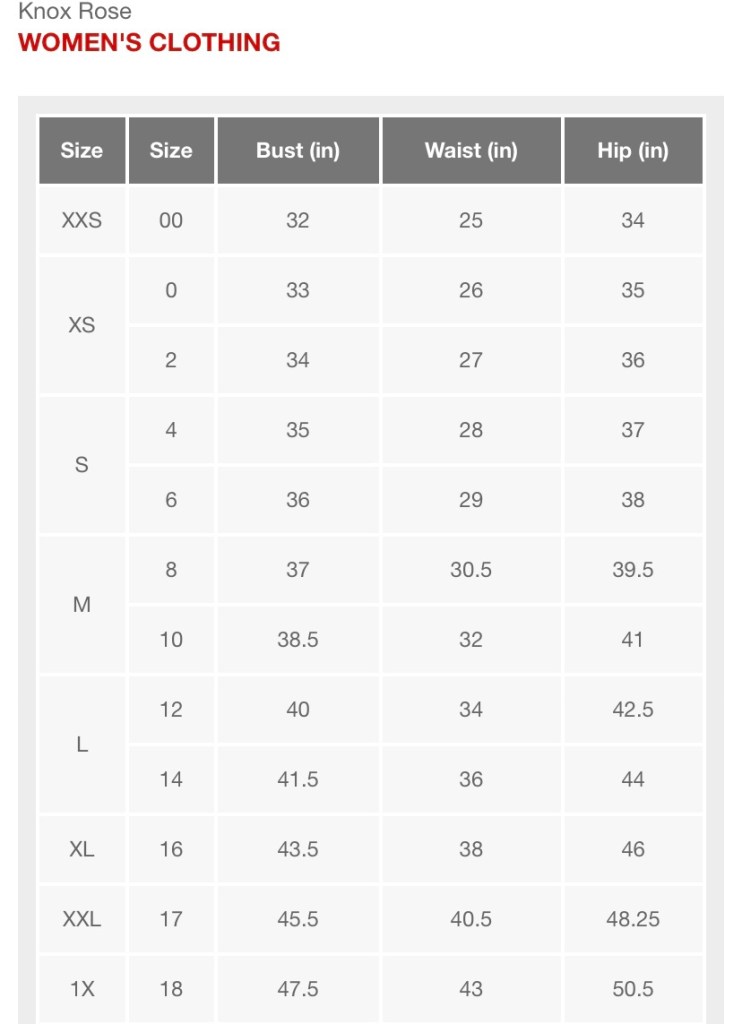
If you have ever used a commercial sewing pattern, you were probably shocked to discover that your ready made clothing size was not your pattern size. For example, currently I’d take size 20 shirt in Butterick patterns, as compared to a size 14 in Target’s Knox Rose brand (1, 2). This is because most women’s clothing manufacturers have adopted vanity sizing. On the surface, vanity sizing may cause us to feel excited about fitting into smaller sizes. But what are the deeper effects of this marketing practice?
Many “brands deliberately skew their sizes, based on the idea that people might feel better if the tag on the clothing says a size (or two or three) smaller than they wear in other brands. This is called vanity sizing” (3).
Brands that tend to run large include Old Navy, Free People, Loft, Lululemon, and Target. These companies often run small by comparison: H&M, Forever 21, Abercrombie & Fitch, and Zara (3 – 5). But really, it’s a case of caveat emptor, or let the buyer beware. Even published size charts are often way off from actual clothing measurements.
While shoppers may find size variation inconvenient, there are deeper problems caused by vanity sizing. According to Illinois State University, inconsistent sizing
“can impact women’s body image confidence negatively. If all clothing brands used the same sizing method, then women’s body confidence would be more positive, and they wouldn’t have to worry about what sizes they fall under. Although vanity sizing can make women’s shopping stressful, it is important to remember that you are not meant to fit into clothes, rather, clothes are meant to fit you” (5). (Emphasis added)
We all know intellectually that a size is just a number and we are far more than an arbitrary number on a label. However, sizing inconsistencies can cause real doubt for some of us. Laura Ash, owner of a business that helps clients with long term health and fitness goals explains that, “We have had clients take a dress out of the wardrobe, put it on, look in the mirror and feel great. But then they catch a glimpse of the label size and feel mortified that it was one of their ‘larger’ dresses and feel terrible about themselves. Even though they looked like a knockout in it and might have bought smaller sizes in other shops that fit perfectly too” (6). For some of us, clothes shopping can even trigger eating disorders like anorexia (6).
In the UK, a study by sociologist Raya Muttarak, from the University of East Anglia (UEA) focused on how “curve” (an euphemism for plus size) and vanity sizing may lead to higher obesity rates (7). She has concluded that “vanity sizing can potentially lead to the misperception of weight status and consequently undermine action to reduce weight” (7).
As we have seen, vanity sizing has some very negative effects on consumers, yet businesses continue this detrimental practice. A study sponsored by the University of Chicago found that it is economically advantageous to keep women who have gained weight in the same size (8). Even though this practice creates more returns, manufacturers will continue to use vanity sizing as long as it remains profitable for them (8). It is interesting to note that this study found little to no vanity sizing for men’s or children’s apparel (8).
How can we deal with the psychological effects of vanity size marketing? Psychologist Jennifer Baumgartner, PsyD, suggests that we look at the piece of clothing and it’s cut without looking at the size on its tag (9). Yes, that’s difficult to do, but we don’t want to be influenced to spend money by marketing. And more importantly, we don’t want to let a number on a label affect our health habits.
I hope that this post has helped you become more aware of the marketing ploys that are being used to increase company profits. Let’s not be influenced by vanity sizing to the detriment of our health. Let’s continue to acknowledge obstacles and overcome them as we maintain our healthy weight.

(3). https://reviewed.usatoday.com/style/features/vanity-sizing-how-shop-retailers-old-navy-loft
(6). https://metro.co.uk/2021/03/06/the-deeply-negative-impact-of-vanity-sizing-13988772/amp/
(8). https://www.sciencedirect.com/science/article/abs/pii/S0167268117300045
 Maintain Weight Loss
An interesting article, for sure. Thanks, again, for all the work you’re doing to help us better understand the tricks companies play to keep us from reaching healthy goals.
LikeLiked by 1 person
I’m glad you like reading them. Thanks!
LikeLike